How your website and Google Business Profile should work together
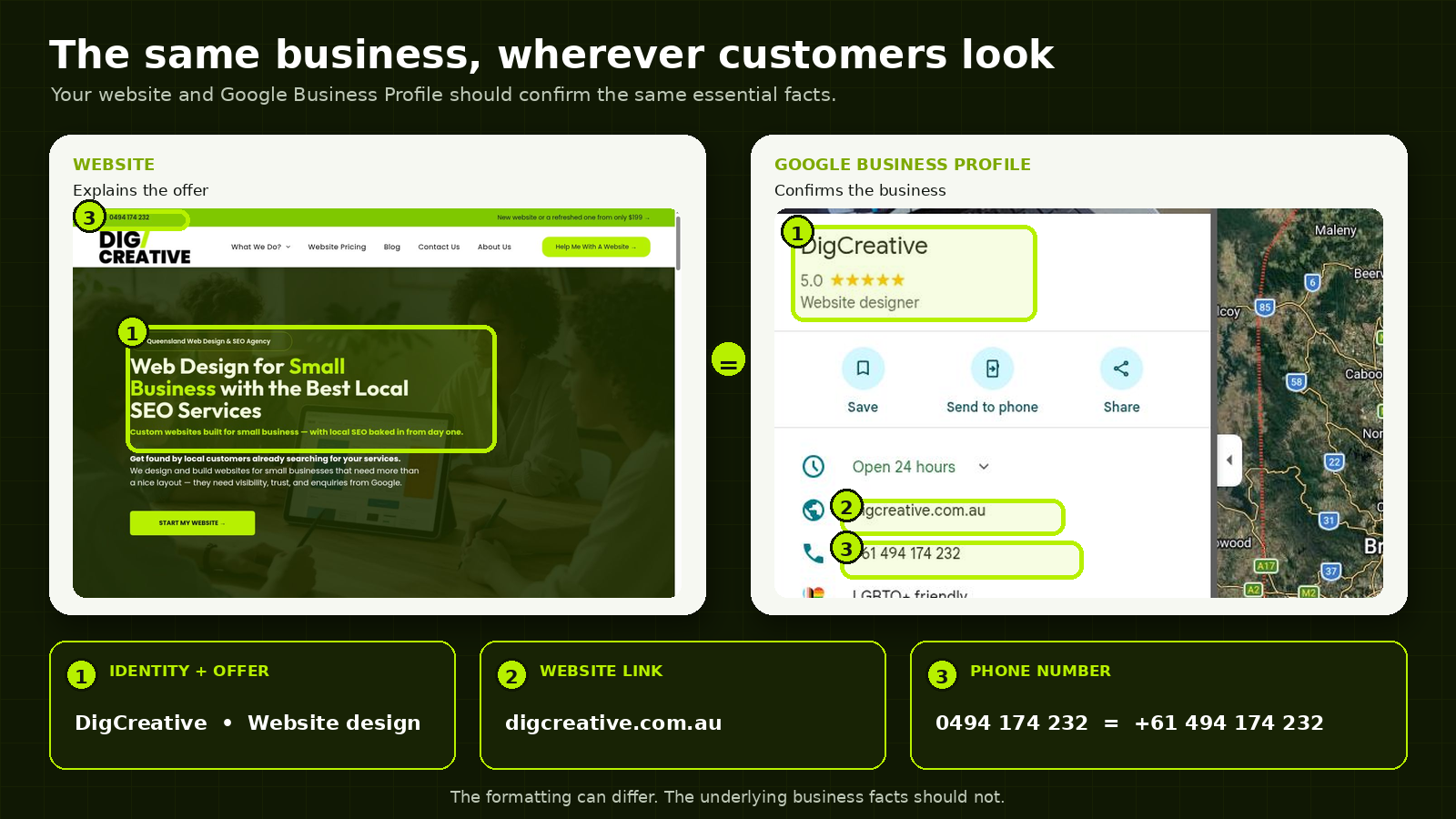
Website and Google Business Profile alignment means your business details tell one clear story across both surfaces. When the information matches, customers can move from Google Search or Maps to your website without hitting conflicting phone numbers, vague services or a different version of the business.
For a small local operator, this is not an abstract SEO task. It affects whether someone trusts the listing, clicks through, calls, asks for a quote or moves to the next result.
The website and profile have different jobs
A Google Business Profile helps a nearby customer discover and assess a business quickly. It can show the category, service area, hours, reviews, photos, phone number and website link.
A website gives the business more room to explain the offer. It can show service details, project proof, pricing approach, FAQs, process and a clear enquiry path.
A Google Business Profile is the local discovery layer. A website is the explanation and conversion layer.
A customer might first see DigCreative on Google Maps, then open the website to check website pricing, examples and contact options. Another customer might find a DigCreative service page in organic search, then check the Google profile for reviews and local legitimacy. Both journeys should lead to the same conclusion.
Google advises businesses to represent themselves consistently in the real world, use accurate service areas and keep profile information complete and current. Google also says local results are mainly shaped by relevance, distance and prominence. Alignment helps with the parts a business can control, particularly relevance, accuracy and customer confidence.
What should match?
The main details should match in meaning, even when the wording is adapted to suit each platform.
Business identity
Use the real business name consistently. Do not add a suburb, service or promotional phrase to the Google Business Profile name unless it is genuinely part of the trading name.
For DigCreative, the core entity should remain:
- DigCreative
- Brad Evans as founder and operator where a person is relevant
- Wamuran, Queensland as the base location
- Moreton Bay and surrounding regions as genuine service areas
- 0494 174 232 as the primary phone number
- hello@digcreative.com.au
as the primary contact email
NAP consistency is the practice of keeping a business name, address or service-area identity, and phone number accurate across the website, Google profile and important listings.
A service-area business does not need to publish a private home address. It does need a consistent and honest explanation of where it operates.
Services and categories
The primary Google Business Profile category should describe what the business is. The website should then explain the services offered within that category.
For DigCreative, the website can clearly cover small business web design, starter websites, website refreshes, local SEO and Google Business Profile optimisation. The profile should use the fewest accurate categories needed to describe the business, while the services section can provide more detail.
A category tells Google what the business is. A service page tells customers what the business can do for them.
Avoid treating every keyword as a category. That creates noise rather than clarity.
Phone numbers, hours and enquiry paths
The phone number displayed on the website should match the number customers see on Google. The click-to-call link should also use the correct machine-readable format, such as
tel:+61494174232
.
Hours should match too. If the website says the business is open while Google says it is closed, the customer has to guess. If the business works by appointment, say that plainly on both assets.
The website button connected from the Google profile should land on a useful page. Do not send a person looking for web design to a generic page that makes them search again.
A good local enquiry path removes decisions. Search, understand, trust, contact.
What mismatch looks like to a customer
Consider a Morayfield trade business with one phone number on Google, an old number in the website footer and a Facebook page using a third variation of the business name.
The customer wonders whether the website is current, whether the business is still operating and which number will actually reach someone.
Search systems also have to reconcile those records. Schema can help label the website entity, but it cannot make conflicting public information disappear.
Aligned versus disconnected